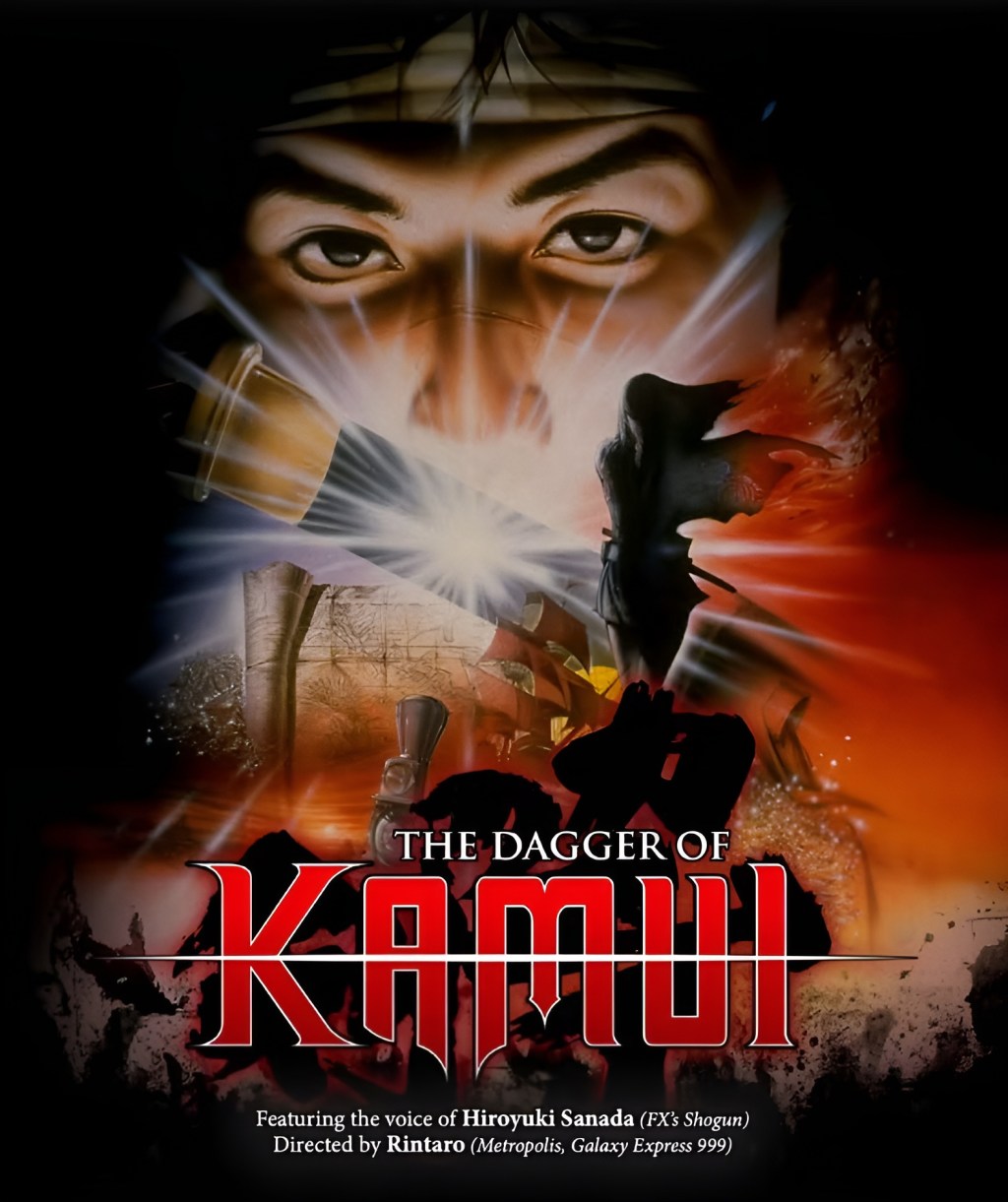
I was lucky enough to get access to AnimEIGO’s release of The Dagger of Kamui early for the purpose of writing an honest review. The release date of this film, debuting on Blu Ray through Media OCD, is April 7, and you can preorder it now.
Here’s what it’s about:
Revenge is a dish best served cold!
On the eve of the Meiji restoration, as a slumbering Japan awakens and turns its eyes westward, an innkeeper finds a baby named Jiro in a drifting boat; his only companion a glittering blade, the Dagger of Kamui. When Jiro is thirteen, his adoptive family is murdered and Jiro is blamed, only to be rescued by Tenkai, a priest, who trains him in the mysterious arts of the Ninja. Seeking revenge for the loss of his adoptive family, Jiro kills the mysterious one-armed Ninja who reportedly slew them.
Years later, acting on a tip from Tenkai, Jiro tracks down his real mother, only to learn that Tenkai had tasked his father with finding a clue to the lost treasure of Captain Kidd. With the treasure in hand, the Shogun will be able to retain control, and Japan will once again isolate itself from the world. However, his father fell in love, abandoned the search, and had a child — and for this failure, Tenkai exacted a terrible revenge!
Now the chase begins, as Jiro, with only the Dagger of Kamui to help him, searches for the great treasure, a search that will take him all the way to the American Old West, with Tenkai’s minions always close behind. If Jiro can find the treasure and return to Japan, then, perhaps, Jiro can exact his revenge and thrust the Dagger of Kamui into Tenkai’s black heart!
I wasn’t sure what to expect when I started watching this film. I had read the summary but avoided watching the trailer because I wanted to be surprised. Indeed I was, because this story has a little bit of everything.
What starts out as a story of personal tragedy and violence morphs into a treasure hunt in a battle against an evil monk and the Shogunate, complete with a side trip to America and appearances from historical figures like Geronimo and Mark Twain (!), and then it moves onto even bigger stakes with the overthrowing of the Tokugawa Shogunate, the Battle of Hakodate, and the Boshin War. (Friends, I had to look some of this history up, even though I lived in Japan for a while, as well as consult the liner notes provided for the film.) We even see the end of Enzo and its renaming of Hokkaido, and then the movie quiets down back to the personal story of Jiro and his quest for vengeance, which leads to a satisfying ending.
What a ride this was! I’ve always been curious about Hokkaido and the Ainu (when I applied to the JET program, it was my number one choice to be placed, but Kumamoto Prefecture selected me), so I was glad to see the story featuring Ainu here, and Jiro being half-Japanese, half-Ainu.
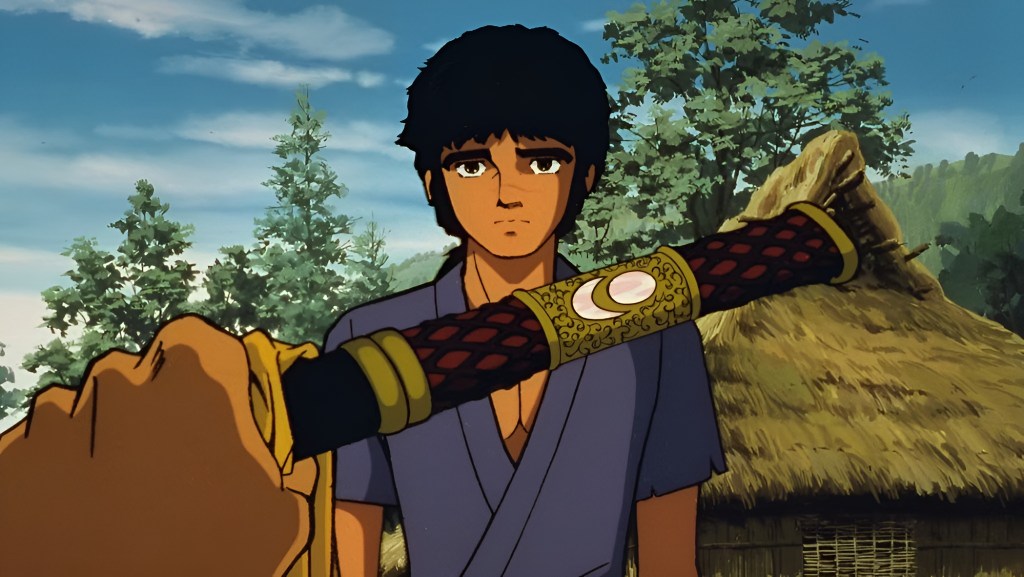
The story is so much bigger than this, though, so we don’t spend a lot of time with the Ainu culture except at the very beginning and partway to the middle, where we are dealing with the formative parts of the story, establishing the murders of both Jiro’s adoptive and blood-related families through the machinations of the evil monk Tenkai, and Jiro’s attempts to reconcile his role in it and to bring Tenkai to justice…a justice which can only mean death.
The trip to America blew my mind. Here I was expecting the treasure to be on the fierce, mystical mountain called Kamui Nupuri like Jiro’s father thought it to be, until all clues lead to Saint Catalina island (considered part of Los Angeles County), and the treasure is attributed to the Captain Kidd. What a twist!
For a while the treasure hunting takes over the story, and I admit I wasn’t as interested in this part. I was hungry for Jiro’s vengeance! But it still tied back to his enemy, the murderous monk Tenkai, who seeks the treasure to support the Shogunate.
Luckily the story resolves that part quickly enough to get back to Hokkaido and Jiro’s personal quest.
We meet an interesting ensemble of characters along the way, like Sam, a slave who is freed by Jiro; Oyuki, an assassin with more to her story than meets the eye; the monstrous Tenkai; and then other side characters consisting of assassins and killers and more shinobi along the way, along with characters who bring support and good wisdom and tragedy.
I’ve never encountered a story quite like this. While there were moments of incredulity for me (like Mark Twain’s appearance, although that was portrayed in a dignified way), overall I enjoyed this film and my heart beat fast at the tense parts, and felt broken during the tragic scenes. This truly is an expansive adventure and I recommend it to die-hard fans of classic Japanese anime and fans of more historical adventures.
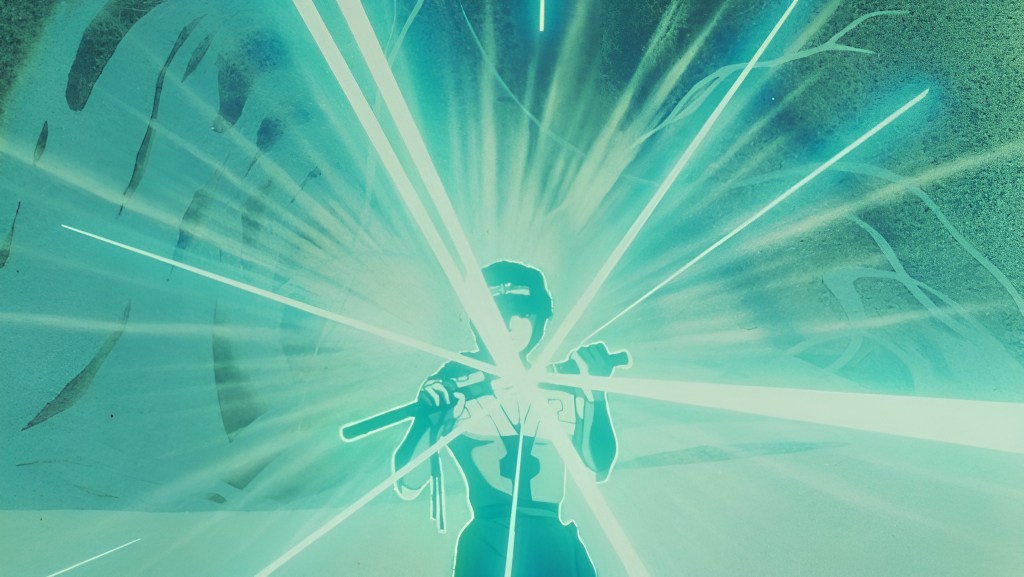
The animation style is typical of its era–the 1980s–but there’s a lot of beauty in this film, from the scenery and background shots to historical details. The tendency for Japanese animation to focus on the eyes and animate them in an expressive way is evident here, with particular moments coming from Jiro and Oyuki.
The fight scenes are good and to show metal crashing on metal, a sort of laser-like effect is used, which made me think of some of the older anime I watched as a child growing up (though nothing like this. I was a Unico kid).
I want to shout out some particularly well-animated but slightly disturbing scenes: the first one is where Jiro and his birth mother are poisoned with a paralyzing drug. It comes on hard and the animation teeters and totters as the characters collapse to the floor, and lines and limbs elongate in disturbing ways. It very effectively and artistically shows the effects of the drugs on the two of them.
Another sequence I’d like to point out animation-wise are the The Matsumae Three, assassins with supernatural elements to them in the way that they fight. They are drawn vividly and in a very unique, fluid way that makes them creepy and otherworldly looking.
The last couple things I want to talk about are the soundtrack and Hiroyuki Sanada’s performance.
First, the soundtrack: this was a blend of rock music mixed with percussive shouts, that sometimes overpowered scenes a little bit, and other times came across as being really cool, like a blend of ancient and modern music (for the time). It played during fight scenes, training scenes, and when Jiro demonstrated determination to move on. The slower songs worked in more serious scenes, and I liked the closing theme, “Kamui no Ken.”
Lastly, the surprise performer in this anime is the famed Hiroyuki Sanada. I had no idea in his illustrious career that he had done voice acting. You may know Sanada from his most recent work, Shogun, but he’s done a little bit of everything, from Shakespeare to horror (The Ring) and more. He’s been steadily performing since the 60s in a wide variety of works, so it really should have been no surprise to me to find him dubbing anime. I don’t know if The Dagger of Kamui is his only work, but his performance is excellent. The character of Jiro hovers between being emotional and stoic at times, and Sanada captures that well.
Overall, this film was a bit of a wild ride. It went places I never expected, combined different types of adventures, with appearances by famed real-life people from American and Japan, all set amid a historical backdrop of turmoil in Hokkaido and other parts of the country.
I asked to review this film because the description of it intrigued me and I liked the character designs, and was drawn to the Ainu influences in the film. I got more than what I bargained for in its expansive storytelling. While this isn’t a perfect film, it makes for a good time.
The Dagger of Kamui (1985) releases on Blu-Ray from AnimEigo, a division of Media OCD, on April 7th. You can preorder the Blu-Ray now.
 Kristina Elyse Butke
Leave a comment