

The picture above is kind of a weird choice, I know. I like the color scheme, but it looks like it’s saying that the expert advice didn’t work and was garbage…and the advice I got from author Tim Waggoner was anything but.
Let me backtrack a little…

I met Tim through my graduate degree program, Writing Popular Fiction, at Seton Hill University. For the duration of your creation of your thesis, you will be assigned two mentors. My genres of choice were horror and fantasy, and while I’ve yet to write a horror novel, everything I write has a hint of darkness to it, especially my forthcoming trilogy, The Name and the Key. So, I was assigned two prolific horror authors to be my mentors.
Tim was the first. I can’t remember how the semesters were divided up between both mentors, but Tim was there while I formulated a story that ended up changing personalities in the middle of writing; rewriting chapter one 9,000 times; and coming up with a plot to the book and then turning around and completely ignoring it. Truth be told, when I came to Seton Hill, I had no plot, no story, no characters…I had no idea what I wanted to write. I just knew that I wanted to adapt Beauty and the Beast into a new story. This ended up not happening. although if you read the thesis, the first quarter of the book has fairy-tale prose and themes to it. Then the book takes on another personality.
Anyway, here’s what you’ve been waiting for: Tim’s advice!
“Don’t fight your process.”
While I was drafting The Name and the Key as a thesis, I was very panicky and needed a lot of reassurance, which Tim provided. One of the things that I constantly wasted time on was trying to write like other writers in terms of how they wrote– their process.
I tried to write every day and couldn’t fit into that mold. I tried to write according to a schedule, a set word count goal, or to end a chapter, and I couldn’t follow that, either. I thought I had to wake up early in the morning to write, or write in the evenings, or pull late nights…the contradictory nature of writing advice was making me anxious. I vaguely remember telling Tim I didn’t think I was doing anything correctly, and trying to change myself was making it worse.
Hence Tim’s words of advice, “Don’t fight your process.”
I’m paraphrasing, I think. It’s been 15 years since I started the program, and 12 since it ended…so I don’t remember the exact phrasing, just the gist. But it was exactly what I needed to hear.
Fighting yourself and your writing process can be a losing battle. The time spent on writing is wasted when you take the time to upend what you’ve always known how to do, especially if it’s how you know you can work.
I was losing myself trying to emulate what other authors were doing because I believed I was wrong, and they were right. There is no such thing in the world of writing.
While I have tried at different points in my life to write every day, to follow a word count, and to have a minimum word count to work towards, I’ve given up on doing that. That’s not me. The only thing I do is that when I do write, I’ll use an Instagram template to share my word count progress for the day…but that’s it.
Something like this…

Anyway, whenever I find myself wasting time by fighting myself, Tim’s words come to mind, and I calm down and try to remember that I am not my own worst enemy and that I should use the process I’m already familiar and comfortable with. Makes sense to me!
Tim Waggoner is a prolific author of horror, weird fiction, dark fantasy, and media franchise tie-ins. Just look at his horror novels alone!
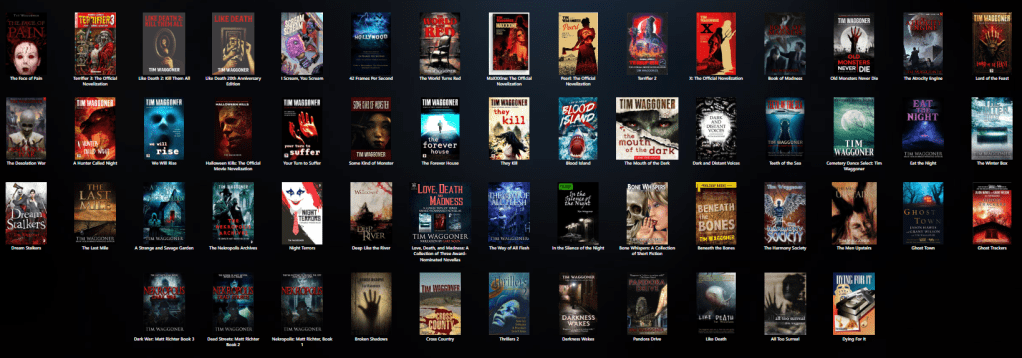
I’m so grateful for Tim’s guidance and advice for my juncture at Seton Hill. The writing lessons I learned from him, not just about the writing life but about my thesis version of The Name and the Key, still serve me to this day.
If you want to know more about Tim’s works, visit his website, his blog Writing in the Dark (which has been running since 2011), and subscribe to his newsletter.
Friends, what are some good pieces of advice you have gotten about writing?

 Kristina Elyse Butke
Leave a comment